


Press
175TH ANNIVERSARY OF THE LANCASHIRE & YORKSHIRE RAILWAY

On Saturday 30th April (10am - 1.00pm), Horwich Heritage will open its latest exhibition celebrating 175 years since the formation of the Lancashire & Yorkshire Railway Company in 1847. The exhibition will run for 2 months until 1st July. In the article below, Stuart Whittle, the Chairman of Horwich Heritage, explains why the L&Y was so important to the development of our area.
Do you remember the highly-acclaimed TV series presented by Adam Hart-Davies called 'What The Victorians Did For Us'. Well you could just as easily produce another one from that era for our local area entitled 'What the L&Y Did For Us'.
I think we all know that the North of England led the way when it comes to the development of the railways in this country - from the work of the Stephensons on the Stockton & Darlington Railway (the first public railway to use steam locomotives in 1825) to the Rainhill Trials in Liverpool in 1829 (won by Stephenson's 'Rocket') which led to the opening of the world's first inter- city railway between Manchester & Liverpool in 1830. Not forgetting, of course, that the first public railway to open in Lancashire was the in fact the Bolton - Leigh railway in 1828.
All the early railways were built and operated by separate companies and, in the case of the Manchester - Bolton - Bury Railway, this was built in 1831 alongside its canal by the Manchester, Bolton & Bury Canal Company who, even at this early stage, had realised the direction in which mass transportation was heading. From its humble beginnings in the 1830s (as the Manchester & Leeds Railway), the L&Y Railway Company, through a series of mergers and takeovers, assembled a network of lines throughout the North of England that by the 1860s ran from Liverpool in the west to Hull in the east, and extended to shipping services to Ireland and continental Europe as well.

The Rainhill trials of 1829
It might have been coal and textile inventions that 'kick started' the Industrial Revolution in the North, but it was the railways that ensured that raw material got to the factories, finished goods got to their markets, workers got to work and they also got to Blackpool for their holidays - and it was all down to the L&Y. By the time of the amalgamation in 1922 which saw the L&Y merged with the LNWR, their main rail network ran for over 600 miles with a further 1600 miles of sidings. There were 290 stations, even more good stations, as well as several large marshalling yards, together with 91 tunnels, 2,478 bridges and viaducts and 733 signal boxes and ground frames. The L&Y built and ran 1,650 goods & passenger locomotives (80% built at Horwich - which we will come to later) which pulled nearly 5000 passenger coaches and 38,000 wagons. It ran 2000 passenger trains a day and 1200 goods trains covering a total of 30.8 million miles. It carried 93.5 million passengers and 30 million tons of freight. And if that was not impressive enough , the L&YR Company operated 28 ships in its Irish Sea and North Sea fleets. The L&Y was most intensively worked general carrier in the UK. It employed 37,000 staff and was a major employer in every Northern town and city.
The first locomotive produced at Horwich Works in 1889 No.1008
Although the L&Y ceased to exist after 1922, through amalgamations that formed the LNWR in 1922 and the LMS in 1923, its influence remained right through to Nationalisation in 1948. Even today, the railway system we see around us is based on that created by the L&Y between 1847 and 1920 - and that includes all the track and stations, from the grandeur of Manchester Victoria to the much -missed provincial stations like Horwich.
 Locally, the L&Y couldn't have had a greater impact, particularly on the town of Horwich. I'm sure most of you are by now familiar with the story of the 'twist of fate' that saw the L&Y purchase a large estate in Horwich in 1884 in order to build a new locomotive works. Almost over night this transformed a sleepy village into a dynamic railway town with workers arriving from all over the country and the population increasing from 3000 to 12,000 in ten years.
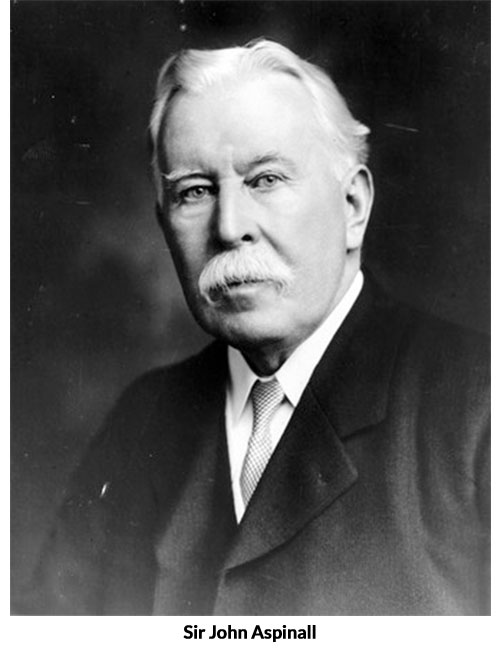
To carry out such a dramatic transformation, the L&Y required someone with a combination of foresight, management skill and technical brilliance, and they found such a man in John (later Sir John) Aspinall. Although he didn't design the Works (that job was undertaken by John Ramsbottom & Barton Wright), Aspinall set about supervising the Works construction, organising the production line and setting up a Mechanics Institute with a premium apprenticeship scheme. The RMI became known as the 'University of Railway Engineering' because of the quality of its apprentices and 3 of these became famous Chief Mechanical Engineers in their own right: Sir Nigel Gresley (LNER), Sir Henry Fowler (LMS) and R L Maunsell CBE (Southern Railway)
Incredibly, John Aspinall also found time to design and re-design goods and passenger locomotives and the very first one to roll off the production line in 1889, an 0-6-0 No.1008, is now proudly displayed at the National Railway Museum in York. During his time as CME, Horwich Works produced a range of Aspinall engines including 2-4-2 Radial Tanks, 0-4-0 'Pugs' and the legendary 4-4-0 'Atlantics', all of which became the 'backbone' of the L&Y operation for the next 30 years. Before he was promoted to become General Manager of the L&Y in 1899, John Aspinall and his team had designed and produced 677 locomotives at Horwich Works, many of which were destined to last until the end of the steam railway era in the 1960s. In 10 years, he had raised the L&Y to the pinnacle of Victorian locomotive construction practice.
Between 1889-1920, Horwich Loco Works produced 1,336 locos, 80% of the L&Y's operational locomotives, and it continued to build and repair locomotives until 1964, after which it produced and repaired diesel locomotives, EMUs, wagons & carriages before it closed in 1983. In its 97 years of operation, the Works built 1,830 stream locos, 169 diesel locos & five 18" gauge locos. It also repaired 50,000 locos.

The last steam loco to leave Horwich Works in 1964 & Horwich Works Erecting Shop 1919
In 1957, the last steam loco built at Horwich left the Works. It was a BR Standard Class 4 No. 76099. This was followed 7 years later in 1964 by the last steam loco to be repaired, a Stanier 8F No. 48756. After closure, the Horwich Works complex continued as an industrial site and remained more or less 'intact' until quite recently. However, the approval of plans for the building of 1700 houses as part of the 'Rivington Chase' development has seen the systematic demolition of most of the Works buildings. At the present time, only the Office Block, Water Tower, Stores Building and Millwrights/Pattern Shop remain to remind Horwichers of their L&Y legacy as one of the 6 major railway towns in this country. - a legacy that they should be extremely proud of!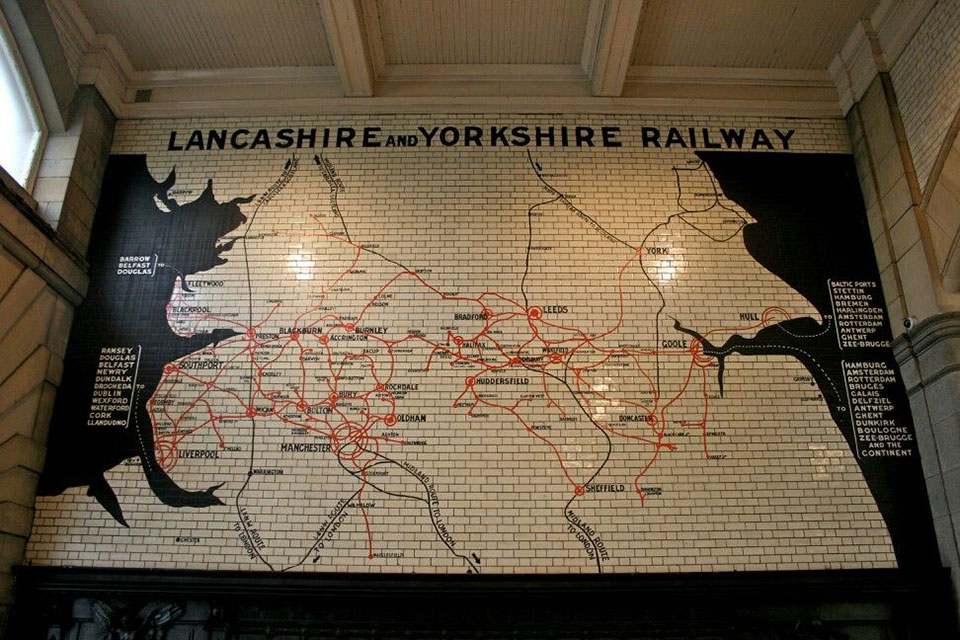
The map of the L&Y network at Victoria Station

A Horwich Heritage visit to the Works in 2018
Stuart Whittle
Acknowledgment: The Lancashire & Yorkshire Railway Society
THE 'TOP SIDE' OF HORWICH
On Saturday 5th March (10am - 1.00pm), Horwich Heritage will be opening its new 'Top Side of Horwich' exhibition and, in doing so, will be able to demonstrate that the history of Horwich is about so much more than the Loco Works (however big a part that might have played).
I think most of us would like to go back in time to see how other people lived - if only for a short period - as we would quickly realise that we are living in a far better time now. In the case of Horwich, the earliest records we have are of primitive humans living on the moors above the town around 1500 - 2500 BC with evidence of stone circles, cairns, flints and axeheads found on Anglezarke Moor, Winter Hill, Noon Hill, Round Loaf and Tigers Clough. Records from then on are a rather limited until the arrival of the Romans in AD 43. There is no evidence of a Roman settlement in our area during their 400 years of occupation other than a fort at Blackrod, although we do know that the Roman army made their way from there to Ribchester via the valley route still called the 'street' in Rivington. Because of certain buildings and place names e.g. Rivington Great House Barn and Anglezarke, we also know that the Saxons and Vikings were here between 400 and 1000AD. But of course everything changed with the Norman conquest in 1066. The land was divided up amongst the Norman Barons and the area around Horwich became a Royal Hunting Forest controlled by the Barons of Manchester. It was in this forest that 'look out' posts were established on high ground to check for poaching e,g, the site of Ridgmont and that vaccaries (small farmsteads) appeared in clearings e.g. the site of Ormston's Farm.
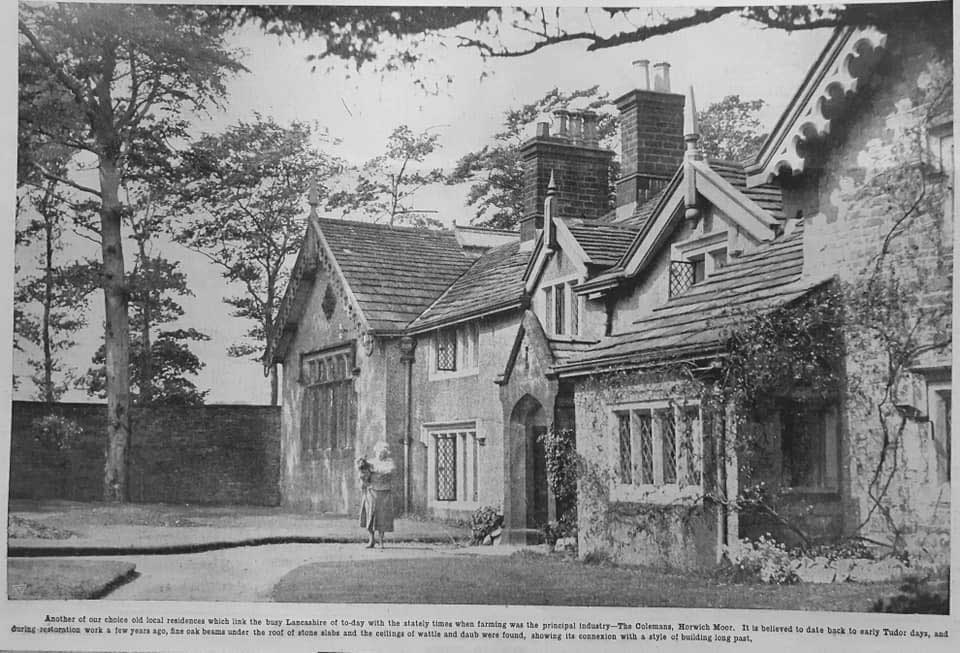
Coleman's - the oldest property in Horwich
The first recorded dwelling in the area is 'Coleman's' at Bottom o'th Moor which appears to have been tenanted by the Greenhalgh family in the C14th and is listed as being occupied by James Greenhalgh in 1425 in an area known as Horwich Lee Wood (part of the Hunting Forest). The Greenhalgh family retained an interest in the place we now know as Bottom o'th Moor until c.1800 running an early textile business. As a dwelling, Coleman's has been extensively altered over the years and is now valued at £3million. In the C19th it was occupied by the Ridgways, the bleaching family who transformed Horwich.

The old Rivington Grammar School
Development in the Middle Ages was slow, but we know that Rivington Grammar School was founded by Bishop Pilkington in 1566 and that a beacon was lit on Rivington Pike to warn of the coming of the Spanish Armada in 1588. William Senior's map of 1620 drawn for landowner Thomas Barton, shows 48 tenanted pastures with names like Urmston, Hunt and Whittle still familiar in the area today. Some cotton yarn was being spun in the farms above Horwich in reign of Henry VIII at places we would recognise like Ormston's, Stonycoft, Hodkinson Fold and Manor House. And it was in this area, alongside the Wilderswood stream, that the origins of the local textile and bleaching industries occurred.

Crowther Fold - birthplace of the textile industry in Horwich
Crowther Fold (built in 1803) is the name most closely associated with this development but at the lower end of the stream (now known as Pearl Brook), Gorton Fold has an equal claim to be the centre of this early industrial activity. In the C17th and C18th, Horwich as a community didn't really exist, the main places of activity being the moorland farms which were connected to the Hoghton causeway (now George's Lane), an ancient upland route to Preston. Bolton Fold (1650) in Bottom o'th Moor was also a prominent farmstead at this time taking advantage of the south facing slopes for atmospheric bleaching.
Life must have been hard in these small, remote subsistence farms but all that changed with the arrival of the Ridgways in 1777. The development of their large scale, steam powered- driven chemical bleachworks at Wallsuches 'kick started' the transformation of a hitherto 'sleepy', scattered community of only 300 people into a thriving village centred on the area we now know as Church Street.

The Clubhouses today
Workers were accommodated in the 'Club Houses' (beginning in 1801) and the Ridways were also instrumental in building a village school (1789) and re-building the Parish Church (1830). The population grew from 300 to 3000 by the mid 1800s and it is interesting to note that, although most people were employed at Wallsuches, the 'cottage industry' of hand loom weaving had not died out but was continued as a 'secondary occupation' in the cellars of the new properties. Not surprisingly, the administration of this new community was undertaken by Joseph Ridway (son of the bleachworks founder, Thomas Ridgway) who lived at Ridgmont, from where he could oversee his bleachworks. He organised village affairs from his 'headquarters' at the Back Bull (now Il Toro), an old stage coach inn and one of 4 public houses in the village at the time. Joseph Ridgway could generally be described as a 'paternalistic' employer who looked after his workforce but his rules were strict and rigorously enforced and he wasn't a man to be crossed. His public 'fall out' with the then Vicar of the Parish Church, Rev. Hewitt is well documented which resulted in him withdrawing his support from the Church until Rev. Hewitt had left and building a mound between Ridgmont and the vicarage on Fleet Street with a statue of his favourite racehorse 'General Jeffrey' on top of it! This mound still exists and is locally known as the 'Hill of Spite'. Despite all this, Joseph Ridgway is respectfully known as the 'Father of Present Day Horwich' for all he did to lay the foundations of the Horwich we know today. Wallsuches and the 'old village' on Church Street remained at the heart of the steadily growing community for over 100 years (1777-1884) until the arrival of the Loco Works heralded a new era for the town that would eclipse everything that had gone before. Thankfully, the former bleachworks (now Arcon Village) and the attractive stone properties, Church, schools and pubs along Church Street remain to remind us of the transformation the Ridgways brought to Horwich.

Wallsuches bleachworks

Wallsuches (Arcon Village) today
It is also worth remembering that the influence of the Ridgways spread beyond the 'old village'. In Bottom o'th Moor, where the isolated farms, had previously combined small scale farming, bleaching and spinning/weaving together with stone quarrying and coal mining, people took up employment at Wallsuches and the Ridgway family themselves occupied both Coleman's and Moor Platt (which was rebuilt in the 1930s), 2 desirable residences in the area. Bottom o'th Moor's origins go back to the days of the Royal Hunting Forest with Coleman's holding the distinction of being the oldest recorded dwelling in the Horwich area (1425). It has always been its own distinct community and, remarkably for such a small place, has been a 'hot bed' of 'Non- Conformity', with 2 places of worship: New Chapel and Horwich Moor Methodist Chapel. New Chapel was built by a group of dissenters who 'broke away' from Horwich Chapel in 1690 and completed their new church in 1716. It still continues as a URC church today. Methodism took root in the homes of local villagers in 1834 who then went on to build a chapel in 1869. It has only recently closed (being converted to a private house) after almost 150 years of service to the local community. Down the years this hamlet has been touched by numerous historical events including skirmishes in the English Civil War (1650-52), the inquest into the 'Murder on the Moor'(1838), at the Moorgate Inn (now the Blundell Arms), the activities of Lord Leverhulme in paying for the choir chancel extension at New Chapel and the renovation of some of the local farms (early 1900s), and being the press HQ (Jolly Crofters) at the time of the Winter Hill air crash (1958). Horwich and Bottom o'th Moor were very much separate communities until the building of the Bolton - Nightingale Turnpike Road in the early C19th. This was the construction of what we now know as Chorley Old Road and dramatically improved the links (still using stage coaches and horse-drawn carts) between Bolton, Horwich, Chorley and Preston. However, even today, Horwich and Bottom o'th Moor remain distinct places.

Wallsuches bleachers c.1890
BOM still has a 'rural feel' with a large number of desirable stone properties dating from the 1800s and, as recently as the 1950s, it was cut off for a number of days because of heavy snow!
'FOOTBALL IN HORWICH' EXHIBITION

Opens Sat. 16th October (10am - 1.00-pm) at the Horwich Heritage Centre, Longworth Road, Horwich BL6 7BG. Runs until Spring 2022.
During the 19th century Horwich was a village of a few thousand inhabitants mostly clustered around the Ridgway's Wallsuches Bleachworks (just off Chorley Old Road).
As in most towns and villages at the time, people had been kicking makeshift balls (pig's bladders etc) around in a fairly haphazard fashion until 'football' started to get organised resulting in the formation of the Football League in 1888 - which contained a strong contingent of northern teams including Bolton Wanderers, Blackburn Rovers, Burnley and Preston North End.
This coincided with the arrival of the Lancashire & Yorkshire Railway Works in Horwich and a population explosion from 3000 to 12,000 in just 10 years. Not surprisingly, with a workforce approaching 5000, the Works was quick to form a team and, in 1896, Horwich RMI arrived, named after the Railway Mechanics Institute where apprentice training and a whole range of social activities took place. Not surprisingly, they became known as the 'Railwaymen' and they played on a ground provided by the L&YR called Grundy Hill.
In the early part of the 20th century, the team gradually worked its way up the local leagues to become a force to be reckoned with in the Lancashire Combination, winning the Cup in 1927-28.

An early photo of Horwich RMI (1880s)
Even in a relatively small town, football wasn't just confined to the RMI. The 'new town' of Horwich saw the rapid construction of houses, churches, schools, shops, pubs and clubs, offices and the emergence of a whole range of other industries like textiles, mining, paper, leather, brick making and sanitary ware. Out of the Churches came the Sunday School Leagues and out of the pubs, clubs and industries came a whole range of teams keen to play in other Saturday and Sunday Leagues. Thanks to the Horwich & Westhoughton Journals of the time, we have a good idea of how extensive these leagues were, and a small number continue to this day.
Meanwhile, Horwich RMI emerged from WWII as a much stronger team and became Lancashire Combination Cup Winners in 1953-54 and 1956-57 and League Champions in 1957-58. In 1968 they moved to the Cheshire County League (becoming Champions and Challenge Shield winners in 1978-79) and in the early 1980s successfully applied to become members of the Northern Premier League. In 1982-83, the Railwaymen reached the first round of the FA Cup, losing 3-0 away to Blackpool, and in 1987-88 they won the GMAC Challenge Cup beating Weymouth 2-0 in the final. However, the 1990s were uncertain times for the club with the closure of the Railway Works (and the loss of the financila support they had enjoyed). The ground was bought by a consortium called Grundy Hill Estates and then sold for housing development with the last match being played on 4th February 1995, almost 100 years after the club had been formed. Fortunately, this wasn't the end of the RMI team who then moved their ground to Hilton Park in Leigh and changed their name to Leigh RMI in 1995-96. And, indeed, the club had a 'golden' 5 year period with promotion to the National Conference League and a top 5 finish in 2000-2001. 2 years before, saw the Railwaymen's most impressive result when they held Kevin Keegan's Fulham (then leaders of Division 2) to a 1-1 draw in the FA Cup 3rd round at Craven Cottage before losing the replay 2-0 in front of a crowd of 7000 home fans. 2000-2001 also saw the team in the FA Cup 3rd round, this time losing 3-0 away at Millwall. At that point, the future looked bright, a change of name to Leigh Genesis and a move to a new ground at Leigh Sports Village seemed to bode well, but things started to go wrong. The chairman and manager left and performances dipped. Successive relegations and low gates meant the club couldn't afford to play at the new ground. It had to ground-share to fulfil its fixtures and finally left the League in 2011. So ended a proud tradition that had lasted 115 years.
In recent years, a new amateur team, called Horwich RMI has been formed and is doing well in the Lancashire Amateur League. Other grassroots teams are also flourishing, not least St Mary's, Old Rivingtonians and ASC Masters and the game now caters for all sexes, ethnicities and abilities.

RMI team: Lancashire Combination Champions & Cup Winners in 1950's
Despite being a small town, Horwich has had a number of football heroes including Les Hamer who refereed at the highest level (including the League Cup Final in 1968) during the 1960s. In 1948-50, Johnny Walton played for England as an Amateur International while Gordon Astall (who died last year at the age of 93) was a winger who played professional football for Plymouth Argyle, Birmingham City and Torquay United and won 2 England caps in 1956. Frank Wignall played for Horwich RMI in 1957-58 before achieving fame as a goal-scoring centre forward with Everton, Notts Forest, Wolves and Derby County between 1958-71. He was capped by England twice in 1964 scoring 2 goals. Former Bolton Wanderers, Manchester City, Derby and England centre forward Francis Lee CBE had a glittering football career between 1959-76, winning League Championship, FA Cup and European Cup Winners Cup medals, 27 England caps and scoring 238 goals. That career started with him playing for Horwich Technical College before joining the Wanderers at the age of 15. One of Horwich's favourite sons is Paul Mariner who sadly died recently age 68. Paul grew up in Autumn Street, Horwich and attended Horwich County Secondary School. He signed for Chorley in 1971 and quickly progressed up the Leagues playing for Plymouth Argyle, Ipswich Town, Arsenal and Portsmouth. He played 35 times for England, scoring 13 goals out of a career total of 188.

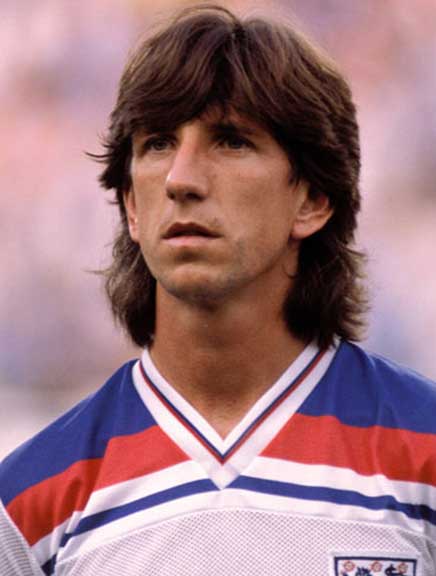
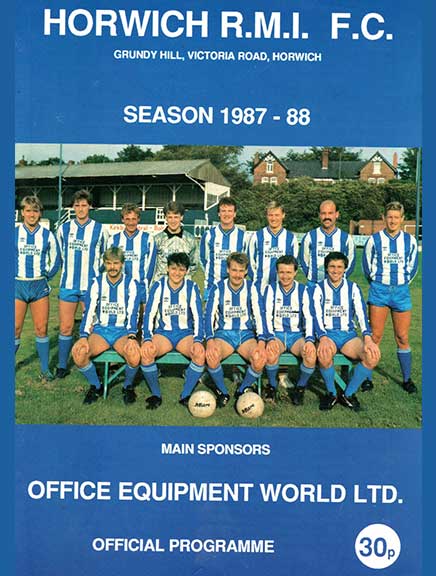
Pictured left to right: Cup Final referee Les Hamer. England international Paul Mariner. RMI programme 1987-88.

RMI ground at Grundy Hill
 In 1983, local boy, Tony Caldwell achieved a remarkable record when he scored 5 goals on his debut for Bolton Wanderers (having signed from Horwich RMI).
In the whole 147 history of Bolton Wanderers, no one has ever scored more than 5 goals in a match, let alone on their debut - what an achievement!
And no doubt there will be more local heroes in the years to come...
So why not visit our exhibition to learn more about Horwich's proud football tradition?
Last picture: St Mary's football club.
Living In BL

Advertiser

WHY NOT JOIN US IN OUR 41st YEAR?
This year's programme is turning out to be another good one and the leaflet with the list of speakers & Open Days for the first half of 2025 is now available from the Heritage Centre. Please renew your membership now. If you are not a member why not join? Only £15 for 11 talks.
HORWICH HERITAGE CENTRE is open every weekday 2- 4pm & Saturdays 10 - 12.30pm. It has a shop, shows and sells films about Horwich and has a range of professional exhibitions and displays to delight all the family. Help is also available for family history and other research. ADMISSION IS FREE!
The monthly OPEN DAYS provide additional exhibitions on topics of local interest. SPECIAL EXHIBITIONS currently running include: Horwich Loco Works, A Victorian Kitchen, The Way We Were, World War II, Winter Hill Mines & the Turnpike Roads. School Parties and other groups welcome.

QR CODE TRAIL
Horwich Public Hall >
Shops & Businesses of Horwich >
MBDA - 80 Years of Manufacturing >
A Brief History Of Horwich Loco Works >
The Story Of The Toll Roads >
The Horwich Station Story >
The Last Train >
The Last Steam Repair >
Navvies' Memorial >
Thomas Hawksley >
Face In The Wall >
The Black A Moor's Head >
Thomas Preston >
Dan Strang & His Walking Stick >
CONTACT US
For all enquiries please email:
kark6767@outlook.com
General enquiries: 01204 847797
Horwich Heritage Centre
Beaumont Road, (off Longworth Road)
Horwich, Bolton, BL6 7BG
Charity Number: 1146434